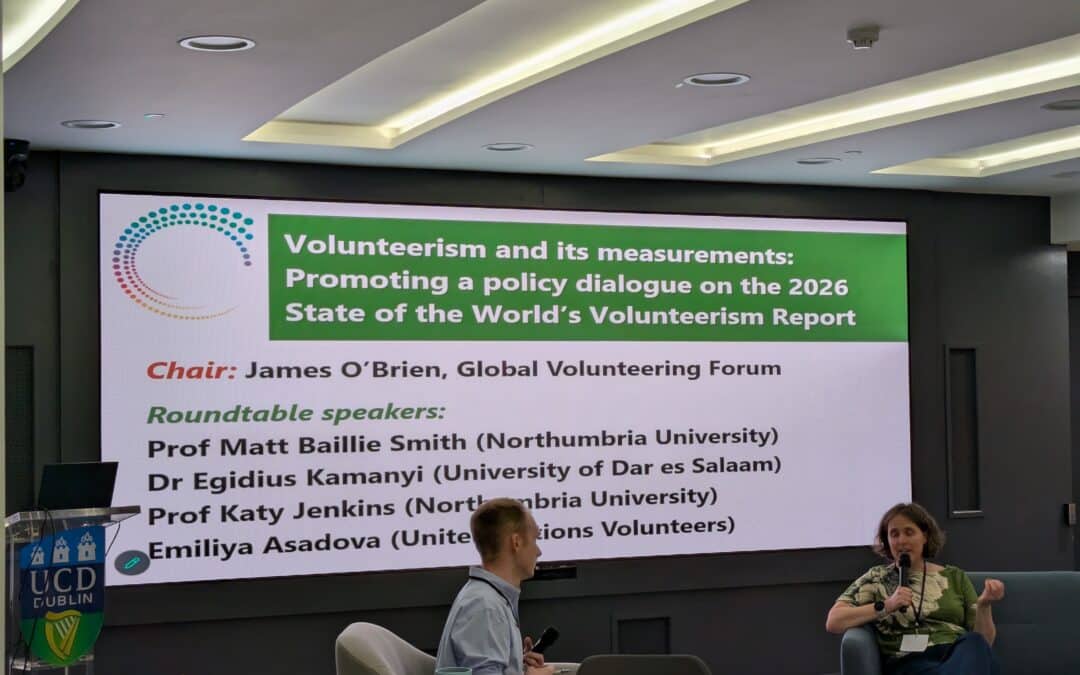
On 7 July, Comhlámh was delighted to co-host a hybrid policy dialogue on the 2026 State of the World’s Volunteering Report – https://www.unv.org/swvr – alongside the United Nations Volunteers (UNV) programme, UCD Volunteers Overseas (UCDVO) and Northumbria University. Held at University College Dublin’s Global Lounge and online, the event brought together NGOs, researchers, policymakers, practitioners and volunteer-involving organisations to discuss a critical question: Are we measuring volunteering in ways that truly reflect its diversity and value?
The discussion was grounded in the findings of the latest SWVR, which highlights significant gaps in how volunteering is measured around the world. While volunteerism plays a vital role in communities, economies and social movements, many forms of volunteer action remain invisible in official statistics and policy frameworks.
The event opened with remarks from Emiliya Asadova, UNV Policy Specialist, who situated the discussion within the wider global engagement process around the 2026 SWVR and the International Year for Volunteers for Sustainable Development (IVY 2026). Participants were invited to consider how volunteer measurement can better support recognition, policy development and investment in volunteering.
The panel discussion, chaired by James O’Brien of the Global Volunteering Forum, featured several contributors to the report. Professors Matt Baillie Smith and Katy Jenkins of Northumbria University explored one of the report’s central themes: that the way volunteering is measured shapes what is valued and who is recognised. They discussed questions of power, inclusion and representation within measurement systems, noting how seemingly neutral frameworks can unintentionally privilege certain models of volunteering while overlooking others. The discussion emphasised the importance of ensuring that volunteer measurement reflects diverse realities rather than imposing one-size-fits-all approaches.
Looking ahead, Emiliya Asadova explored how improved measurement systems could better support policy development, funding decisions and recognition of volunteers. She highlighted opportunities for governments, civil society organisations and international bodies to work together in developing more inclusive and meaningful approaches to collecting and using volunteer data.
Following the panel, participants took part in interactive group discussions, with in-person attendees having the opportunity to test a new game that is being developed to encourage exploration of the dynamics of impact measurement, including who influences decisions and approaches, and how this happens. The event concluded with an input from Dr Egidius Kamanyi, who drew on his research in Tanzania to reflect on the many forms of volunteering that often go uncounted in official data, particularly in Global South contexts. Community-based mutual aid, informal support networks and locally rooted forms of collective action can make substantial contributions to social well-being, yet they are frequently absent from national statistics.
For Comhlámh, the event reinforced the importance of viewing volunteering through a global citizenship lens. Understanding who volunteers, how they contribute and what impacts they create requires approaches that respect diversity, context and lived experience. If volunteer contributions are overlooked, there is a risk that policies and resources will fail to support the individuals and communities driving positive social change.
We would like to thank our co-hosts UNV, UCDVO and Northumbria University, as well as all the speakers and participants who contributed to such a thoughtful and engaging discussion. The conversations demonstrated a strong shared commitment to creating more inclusive ways of understanding, measuring and supporting volunteering in all its forms.