
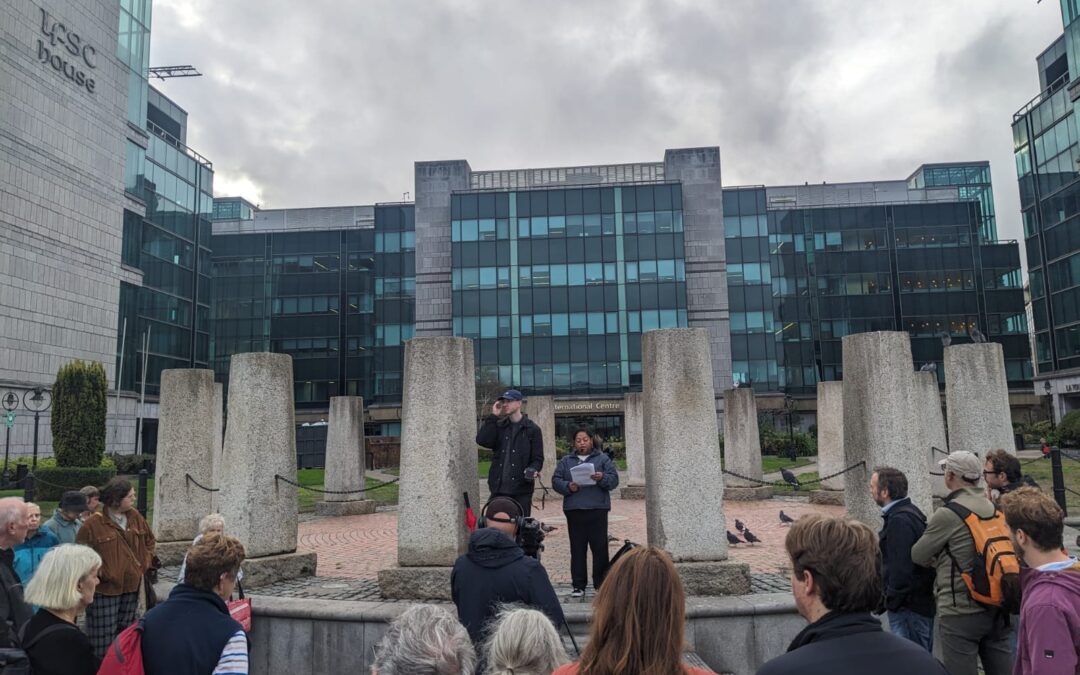
“The money moves, but the decision-making doesn’t. The resources move, but the expertise is still assumed to sit somewhere else. The language changes, but the relationship doesn’t.”
In her latest reflection, Bronwyn April asks us to look beyond the language of climate justice and examine the relationships of power that sit underneath it.
Drawing on her own experience of being from South Africa and the Global South while now living and working in Europe, Bronwyn begins with an uncomfortable recognition: she is both critical of unequal global systems and someone who benefits from them. Rather than avoiding that contradiction, she uses it to ask what genuine climate justice requires of all of us.
Her reflection moves through questions of colonialism, extraction, reparations, development, climate finance and the Sustainable Development Goals, but keeps returning to one central issue: who has the power to decide?
Who decides what repair looks like?
Who decides where resources go?
Whose knowledge counts as expertise?
Who gets to define the problem and design the solution?
And what happens when communities say, “That isn’t what we need”?
Bronwyn challenges the idea that changing our language is enough. We can speak about solidarity, participation and decolonisation while continuing to make decisions in the same ways and from the same positions of power.
She also turns the questions back on ourselves. Good intentions, she argues, are not enough. We can care about climate justice and still benefit from injustice. We can want to help and still cause harm. We can support redistribution and decolonisation until those principles require something of us personally.
For Bronwyn, the challenge is therefore not simply to ask what can we do? but to ask what needs to stop, move, be redistributed or given back — and ultimately, what we might be willing to give up.
This is a reflection about climate justice, but also about power, accountability, solidarity and the difficult work of changing our own position within the systems we seek to change.
At its heart is one question:
Who gets to decide what justice looks like?
Read Bronwyn April’s full reflection HERE
This paper was authored by Bronwyn April (Dublin, 2026). It’s licensed under Creative Commons Attribution-NonCommercial 4.0. You are free to distribute, remix, adapt and build upon the material for non-commercial purposes, so long as appropriate attribution is given.
Comhlámh is grateful to Irish Aid at the Department of Foreign Affairs and Trade (DFAT) for ongoing funding support for our work. Irish Aid is “the Government’s overseas development programme which supports partners working in some of the world’s poorest countries. Irish Aid also supports global citizenship education in Ireland to encourage learning and public engagement with global issues”. This publication does not necessarily represent or reflect DFAT policy.